
For many adults living in New York City, improving their smile has become an important personal goal. Whether you’re working in a professional setting, attending social events, or simply wanting to feel more confident, straighter teeth can make a meaningful difference.
But when it comes to orthodontic treatment, one question often comes up:
Should you choose Invisalign or traditional braces?
Both treatments are designed to straighten teeth and improve bite alignment, but they work in different ways and may suit different lifestyles.
At SoHo Smile in New York City, many adult patients ask about the differences between Invisalign and braces before deciding on treatment. Understanding how each option works can help you make a confident decision that fits your goals and daily routine.
Let’s take a closer look at how Invisalign and braces compare.
Why More Adults in NYC Are Considering Orthodontic Treatment
Orthodontic treatment is New York no longer just for teenagers. In fact, many adults in New York are choosing to straighten their teeth later in life.
Common reasons adults pursue orthodontic treatment include:
- Improving smile appearance
- Fixing crowded or crooked teeth
- Correcting bite alignment
- Addressing gaps between teeth
- Supporting long-term oral health
For people living in a city as social and professional as New York, a confident smile can influence both personal and professional interactions.
What Is Invisalign?
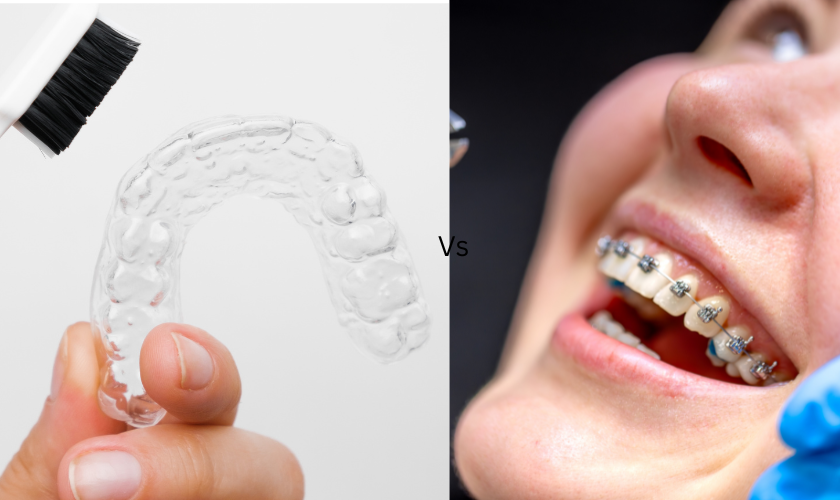
Invisalign is a modern orthodontic treatment that uses clear plastic aligners to gradually move teeth into the desired position.
Instead of brackets and wires, Invisalign uses a series of custom-made trays that fit snugly over the teeth.
Patients wear each set of aligners for about one to two weeks before switching to the next set in the series.
Over time, these aligners gently guide teeth into alignment.
One of the biggest advantages of Invisalign is that the aligners are nearly invisible, which is why many adults prefer this option.
What Are Traditional Braces?
Traditional braces use metal brackets and wires attached to the teeth to move them into proper alignment.
The brackets are bonded to the front of each tooth and connected by a wire that gradually shifts the teeth over time.
Dentists periodically adjust the wires during follow-up appointments to continue guiding the teeth into their ideal position.
While braces have been used for decades, they remain one of the most effective orthodontic treatments for complex cases.
Invisalign vs Braces: Key Differences
When choosing between Invisalign and braces, several factors should be considered.
Below is a side-by-side comparison to help you understand how each option works.
Appearance
For many adults in New York, appearance is one of the most important considerations.
Invisalign
Invisalign aligners are clear and difficult to notice during everyday conversations.
Many people can undergo treatment without others realizing they are straightening their teeth.
Braces
Traditional braces use visible metal brackets and wires, which are more noticeable when smiling or speaking.
However, modern braces are smaller and more discreet than older versions.
Comfort
Comfort can vary depending on the type of orthodontic treatment.
Invisalign
Invisalign aligners are made from smooth plastic, which tends to feel more comfortable against the cheeks and gums.
Because there are no wires or brackets, irritation inside the mouth is usually minimal.
Braces
Braces can sometimes cause irritation where brackets rub against the inside of the cheeks.
Adjustments to wires may also create temporary discomfort after orthodontic appointments.
Convenience
Busy schedules are common for adults in New York, so convenience plays an important role in treatment decisions.
Invisalign
Invisalign aligners are removable. This means patients can take them out when eating, drinking, brushing, or flossing.
This flexibility makes it easier to maintain normal eating habits and oral hygiene routines.
Braces
Braces are fixed to the teeth and cannot be removed during treatment.
Patients may need to avoid certain foods, such as sticky or hard items, to prevent damage to the brackets.
Oral Hygiene
Maintaining good oral hygiene during orthodontic treatment is essential.
Invisalign
Because aligners are removable, brushing and flossing remain simple.
Patients can remove the trays and clean their teeth normally.
Braces
Brushing and flossing require more effort with braces since brackets and wires can trap food particles.
Special tools may be needed to clean around the brackets.
Treatment Effectiveness
Both Invisalign and braces can effectively straighten teeth, but the best option depends on the complexity of the case.
Invisalign
Invisalign is often recommended for mild to moderate alignment issues.
Braces
Braces may be better suited for complex orthodontic cases involving severe crowding or bite problems.
A dental consultation can determine which option is most appropriate.
Treatment Time
The length of orthodontic treatment varies depending on the individual case.
In general:
- Invisalign treatment often takes 12–18 months
- Braces may take 18–24 months in some cases
However, treatment time ultimately depends on the specific alignment issues being addressed.
Lifestyle Considerations for New York Adults
For adults living in Manhattan or other parts of New York City, lifestyle factors can influence orthodontic decisions.
Professionals who frequently attend meetings or networking events may prefer the discreet appearance of Invisalign.
Others may prioritize the effectiveness and reliability of braces, particularly for more complex alignment issues.
Ultimately, the best choice depends on your dental needs, lifestyle, and personal preferences.
The Importance of a Professional Consultation
Choosing between Invisalign and braces is not always straightforward.
A professional dental evaluation can assess factors such as:
- Tooth alignment
- Bite issues
- Jaw positioning
- Overall oral health
Based on these factors, a dentist can recommend the most suitable treatment option.
At SoHo Smile, consultations help patients understand their orthodontic options and choose the solution that aligns with their goals.
A Straighter Smile Can Improve More Than Appearance
While many people pursue orthodontic treatment for cosmetic reasons, straighter teeth can also support better oral health.
Properly aligned teeth are easier to clean and may reduce the risk of:
- Tooth decay
- Gum disease
- Uneven tooth wear
- Jaw discomfort
For many adults, orthodontic treatment is both an aesthetic and health investment. Visit us to know more.
FAQs
Is Invisalign better than braces for adults?
Both treatments can be effective. Invisalign is popular for its discreet appearance and convenience, while braces may be recommended for more complex orthodontic cases.
How much does Invisalign cost in New York?
The cost of Invisalign can vary depending on the complexity of the case and treatment length. A consultation with a dentist can provide a personalised estimate.
Are braces faster than Invisalign?
Treatment time depends on the specific dental issues being corrected. Some cases may progress faster with braces, while others respond well to Invisalign.
Can adults still straighten their teeth?
Yes. Orthodontic treatment can be successful at almost any age as long as the teeth and gums are healthy.
Which option is more comfortable?
Many patients find Invisalign more comfortable because the aligners are smooth and removable, though comfort levels can vary between individuals.